
The AI-defined data center for machines that move.
Roadmap, stated plainly. Each element ships when its evidence does.
Resilience without dead weight.
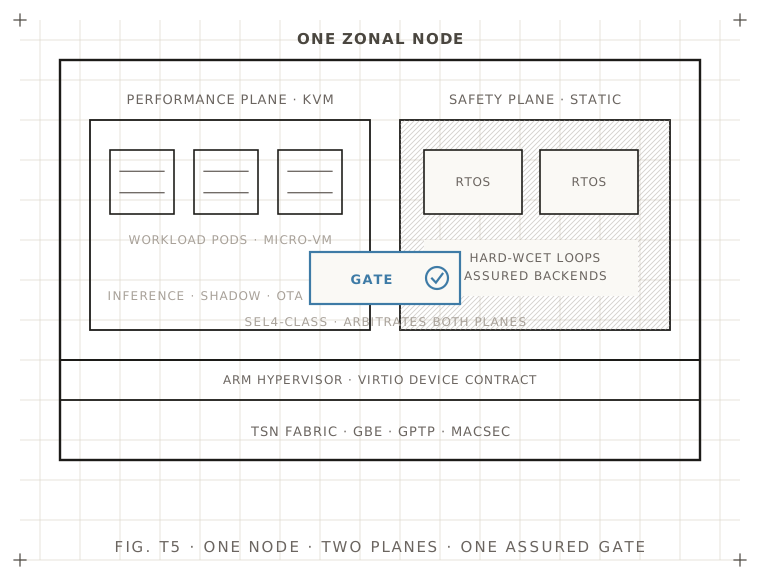
A hyperconverged zonal node consolidates ECUs, HPCs, and controllers onto shared silicon. Today's 1:1 standby computer is dead weight — an N:1 cluster shares one standby across many workloads. The failover itself leaves evidence.

The vote proposes. The monitor decides.
Diverse models vote — for availability, not for safety. A small assured monitor and an independent fallback carry the safety claim. Disagreement routes to the fallback, and every decision leaves a record.


One silicon, two worlds.
An Android Automotive OS consumer plane and an assured plane share the cockpit — the assured plane owns the telltale path. Display-integrity attestation closes the loop: our claim stops at the display controller's output.


Android and Android Automotive OS are trademarks of Google LLC; references are nominative.
Rollback, not recall.
New software runs shadow-mode beside production until its evidence clears the gate. Then cutover takes a reboot — not a night.

In today's E/E architectures an update crawls box to box: dozens of ECUs fed over low-capacity serial links. Reported industry cases have run past ten hours — long enough to deplete the battery mid-update, strand the vehicle, and turn a software rollout into recall-class cost, up to and including battery swaps just to get the update installed.
On the hyperconverged node the new version is fully enrolled before anyone commits to it. Containers are staged, integration is complete, and the release has already run in shadow mode against live traffic — beside the fleet, holding no authority — until its evidence cleared the gate.
Cutover is a boot-order change. The node — or the individual VM guest — simply boots the new version. It is the cut-over–style migration that has carried data-center fleets for two decades, brought to the machine: update time collapses from hours of transfer to node-boot time, under a minute by design. That is what makes mass-scale, fleet-wide rollouts routine instead of an event.
The previous version stays warm through its retention window. If the rare regression surfaces in production, rollback is the same move in reverse — one decision, boot time, no recall. Every stage, cutover and rollback is evidence-logged and attributable.
The headroom that makes this possible is the same N:1 argument as failover: spare capacity per ECU is expensive; consolidated overprovision is marginal — and it buys resilience and instant updates at once.
Built for contested links.
LEO, 5G-Advanced, 6G-ready — bonded paths that degrade gracefully. Dual use by design: the same platform serves civil fleets and defense programs. The platform goes further: it anticipates the network before the road — the Anticipation Layer →

The chain does not stop at the fleet.
An operator does not hold the whole story. An authority requires an action and asks, later, how much of the fleet it actually reached. The person who owns the vehicle decides when — or whether — it installs. Both answers have to survive being read back months later, which means both have to be recorded at the moment they happen, by the party that holds them.
Consent is recorded, and so is a deferral. A request from an owner's phone, a vehicle HMI, a fleet partner's API or a workshop tool enters through one governed door, gets a policy verdict, and leaves a record — including the refusals. The platform serves no consumer interface; it holds the evidence of what was asked and answered.
A deferred endpoint is counted as a cohort exception, never as converged. At fleet scale that is the largest single source of drift between the desired state and the actual one — a figure to be evidenced rather than smoothed. Fleet customers operate a narrower scope of the same ledger, not a copy of it.
Reach is reported with the owner-deferred share intact, and labelled with its sampling basis: exhaustive on metadata, sampled on full attestation per cohort, complete on exceptions. A corrected figure is a new attestation, not an edit.

A deferral is a lawful answer. It still has to be counted.
The staircase, not the leap.
QM and lower-integrity workload pools come first. Hosting the highest-integrity workloads is the roadmap's north star — gated on assessor acceptance, not on our own confidence.
And further out, labeled clearly as roadmap: household vehicles sit parked roughly 95% of the day (FHWA 2022 NHTS). Partitioned idle capacity is an OEM TCO offset waiting for its evidence.
The operator console for all of this already has a face — Explore the Bridge — design prototype → (gated; every number illustrative).